New Year, New Niggle
For the last few years January seems to have been the month of set backs in my training. I seem to greet a new year with a new injury or a recurrence of an old one. January 2019 has brought with it the gift of a new niggle, this one being a bit of a mystery.
I’ve been struggling with my left calf. It’s not like all the calf injuries of the past that have been straightforward tears or strains in the belly of the muscle. This one is on the inside of the muscle, very close to where it connects with the shin bone. It doesn’t feel like it’s about to tear, but rather it seems to get inflamed and create a significant area of tenderness down the inside of the calf/ shin or specifically the medial tibial periosteal region. It causes lots of soreness during the first 15 minutes of running and then as I warm up it seems settle down and the intensity of the pain dissipates. As a result, it hasn’t stop me from training but it is restricting the type of run sessions I can do and it does cause lots of discomfort between sessions. My massage therapist has been working hard on it to relieve the symptoms and I’ve been icing the whole area every day but it doesn’t want to go away.
Because its not been an acute injury, a moment in time where I can pinpoint something that happened that caused the injury and because it’s not been preventing me from training I’ve been guilty of ignoring its significance, or potential significance.
But as its a massive year for me I can’t afford to ignore the signals my body is giving me and run the risk of creating a really chronic injury for myself.
So after a full 4 weeks of being in denial I finally did the smart thing and reached out to some experts for help. Firstly I found an excellent physio, Kathryn Fishlock in Newport who gave me a thorough examination and then introduced me to a bit of funky kit called an anti-gravity treadmill. It works by pulling on a pair of sealed shorts that can then be inflated to hold the body above the treadmill in such a way that only a limited percentage of overall bodyweight is being put through the legs. Thus running can still be possible whilst carrying an injury. Kathryn wanted to assess how my running gait would change as more of my body weight was reintroduced. The good news was that nothing changed and she was happy with my running action. So she came up with a few exercises to try to help strengthen this area.
Anti-gravity treadmill running is amazing. Removing 10% body weight makes a massive difference. I felt like I was running on a cloud, it was effortless. For an experienced and competent runner like me it was such a revelation so I can’t begin to comprehend just how much of a difference it would make for others who are significantly heavier and less used to running. For anyone who knows that they are carrying too much weight and wonders what it would feel like to run without these extra kilos then go and try one of these things. It is incredible. It is a powerful way of understanding just how much better you will feel once you have got the weight off and thus should provide an enormous boost in motivation for sticking with the process of shedding excess weight.
So I got stuck into the rehab exercises but frustratingly, two weeks on nothing had improved and so I decided to take up a referral from Kathryn to see an eminent sports doctor, Geoff Davies in Cardiff . Geoff examined my lower legs and decided that an MRI was required so a few days later I was back in Cardiff for the scan.
I think he was concerned that there may have been a stress fracture in my shin. The results came back really quickly and the good news was that there was no evidence of any stress fracture and the only anomaly was a build up of scar tissue in the area of pain. His report noted that the scarring was clearly a relic of previous calf injuries as at the area of maximal tenderness there is quite florid scarring and abnormal signal in the tibial origin of the tendon of the medial head of soleus. There is some ossification in the tendon at the origin with some low-grade oedema around it. The scarring of the central tendon extends distally in the calf. The tibia is normal with no evidence of stress fracture. There is also scarring of the myo-aponuerosis between the soleus and the medial head of gastrocnemius compatible with previous injury.
Reassuringly there is no evidence of tibial stress fracture, which was my major concern. His symptoms appear to be related to chronic scarring of medial soleus / calf which does fit with his history.
However, the scarring was almost identical on the right leg and so it was confusing to me that it could be causing pain on the left leg but not on the right. But what do I know?
Geoff’s recommendation was to continue with physiotherapy and consider a formal biomechanical assessment with Podiatrist Tom Cooper at Ace feet in Motion in Cardiff.
So off I went to meet Tom. This was another fascinating experience. Tom also works with lots of elite sports people and so I knew I was in good hands. He got me to walk barefoot over his sensor pad that built a digital picture of how my feet were striking the ground, especially where the pressure points were throughout the process of making a forward step. Again, good news in that there was nothing dramatic that was going on that could be contributing to my discomfort. He did identify a minor flaw in my big toe ( the same on both left and right foot) that creates a slight restriction in the drive phase of a step, but felt that this was not creating the pain and was concerned that if he tried to correct it we may cause problems elsewhere and so it was best to leave it be. Everyone is different and very few of us have perfect biomechanics and we don’t require perfection to perform consistently well.
We then moved into his run studio where a larger sensor mat is set up. Run shoes were put on and then I was asked to run up and down over the matting. Tom observed and built a similar footstrike profile using the data that was coming from the sensor mat. The result was consistent with the barefoot walking. Apparently, I have good biomechanics and have a very consistent, efficient and balanced run pattern. I strike the ground with my midfoot, am not overstriding and thus put very little weight through my heels. All in all, excellent feedback.
So my third expert is telling me that all the essential ingredients to effective running are in place and looking good. This is obviously great to know, but frustratingly doesn’t mean that the pain in my medial tibial periosteal region is any less!
So Tom suggested three possible routes for solving my problem. Firstly I could try orthotics, but I’ve been down this road before and found that whilst it helped in the short term it created much bigger problems in the longer term, so I am really adverse to going this route again. Secondly he is having some positive results with shock wave therapy that fires sound waves into the tissue to accelerate blood flow and healing. He has been using it for achilles and plantar fasciitis injuries and thinks it could help. I’m thinking this through right now.
The third route is a strength and conditioning programme for the Tibialis Posterior region.
My instinct told me to go with the strengthening programme first and see if we can deal with it that way.
So I’m now having to spend time, several times a day rigorously executing these tiny exercises that hopefully will help to rebuild my muscles so that the pain will disappear.
The good news is that I get feedback every time I run. Encouragingly, the length of time that I am experiencing pain at the start of every run is shortening and so this gives me motivation to continue with the rehab programme. I’m now confident that I’ll overcome this latest niggle and that it wont derail my season.
So whilst I haven’t yet resolved the problem and I haven’t discovered the definitive answer to the question about what is causing the pain, I’m really glad that I didn’t just ignore it as I’ve learnt so much by meeting these three experts over the last month.
And, importantly, I’ve now got an even wider team that I can turn to when I need help in the future.
I’ve learnt that the human body is a complex and sometimes contrary being. It can flummox experts and often there isn’t a simple linear answer to what may appear to be a simple problem. Thus, we need to be open to a test and learn approach to problem solving. Furthermore, niggles are often a result of a slight imbalance that requires a disciplined dedicated time consuming programme of dull exercises to remedy. As we get older we ignore the basics of strength, conditioning and balance at our peril.
Keep at it, its worth it!
 In the days after the race in Port Elizabeth in September it all seemed so simple. Take a few weeks off then put together a solid block of ten weeks training, travel out to Bahrain five days before, adjust to the warmer climate, relax, put in another performance like South Africa and fly home with the 2019 place in the bag. What could possibly go wrong?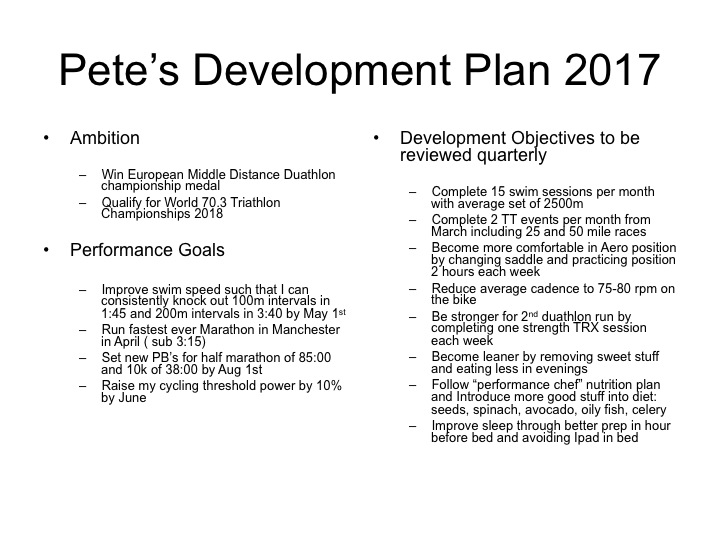
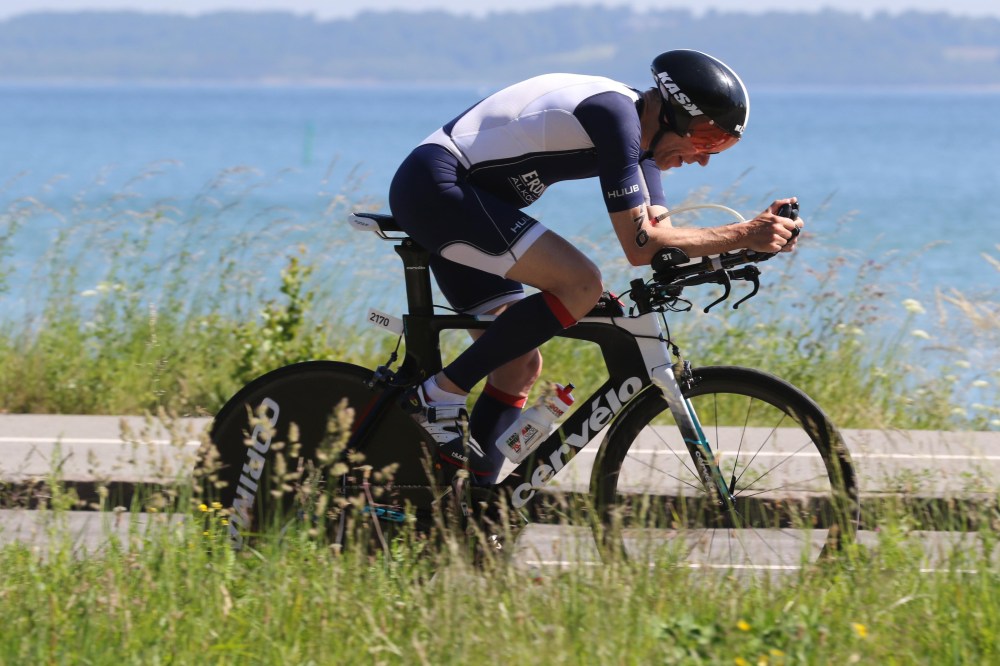 Doing this has helped me to find a cadence that works for me and given me more confidence for race days, so another big tick. However, I have to confess that I failed miserably with my objective to race more TT’s in 2017. ( I think I did one!) I can’t explain this, as I love the simplicity and purity of a TimeTrial and I even have a regular Thursday evening event that goes virtually past my house. Maybe I was just unrealistic in what I could fit into my training programmes?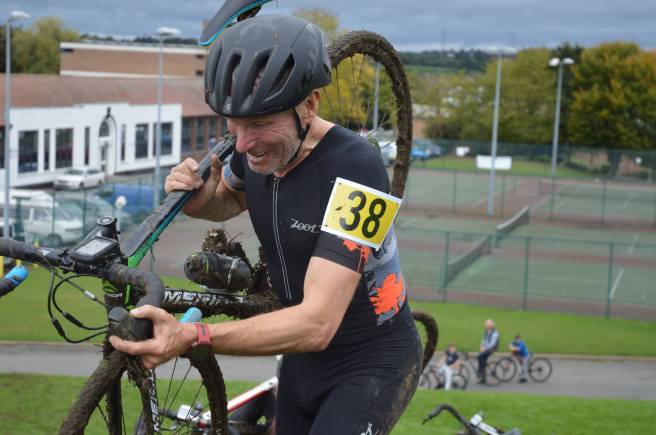
 If pottering around slowly was creating challenges that were proving difficult then how would I cope in the heat of the race battle? I was very quickly realizing that riding offroad in deep mud was very different to my usual road cycling. I was way out of my comfort zone, deep in the land of the conscious incompetence and concerned that I may visit unconscious incompetence several times more before the day was out! But, heh I wanted a challenge. I wanted to test myself with some new stuff and it felt like I was being thrown in at the deep end, only this time it was deep mud rather than deep water.
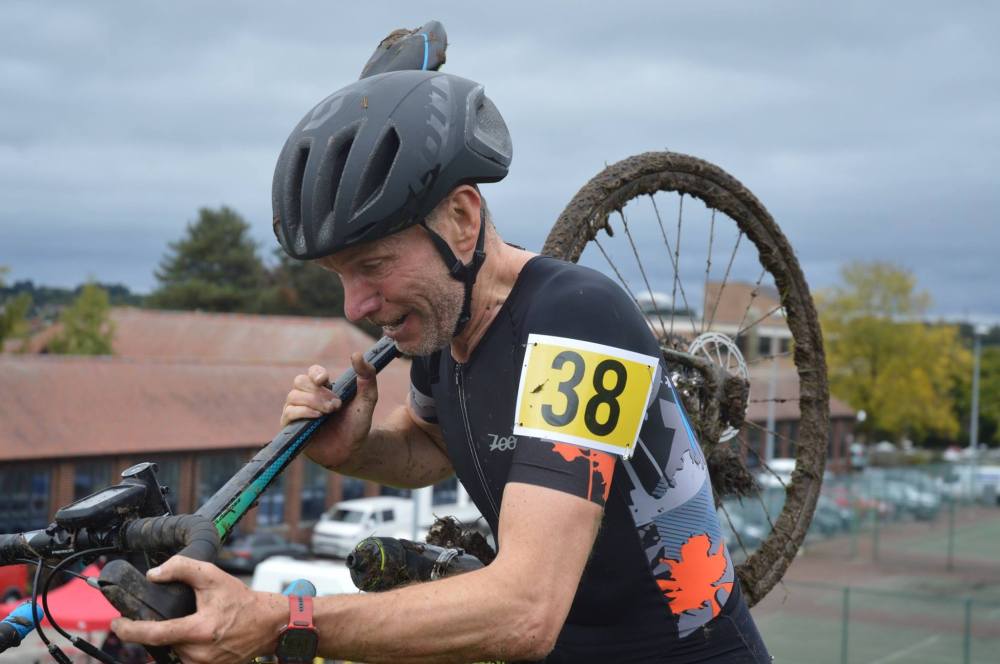 Somehow I got through the technical section without causing anymore damage to the other racers, but I did block the route a few times as I lost my balance and ended up in brambles and undergrowth. Once back out onto the open section we headed up hill and my strength became an advantage. I started to overtake people as the first lap ended and this gave me a bit of confidence. With confidence came the ability to assess what was happening. I broke the course down into sections, some of which I could attack full gas and others where I needed to take it steady. As the laps went by I also began to learn how to ride through the thick sticky mud. It needed to be attacked with a high cadence in a straight line. As each lap went by I went quicker and quicker and was definitely making my way through the field. 60 minutes went by in a flash and I could now hear the last lap bell. After a very tricky start I’d really enjoyed my debut at cyclocross and didn’t really want it to end.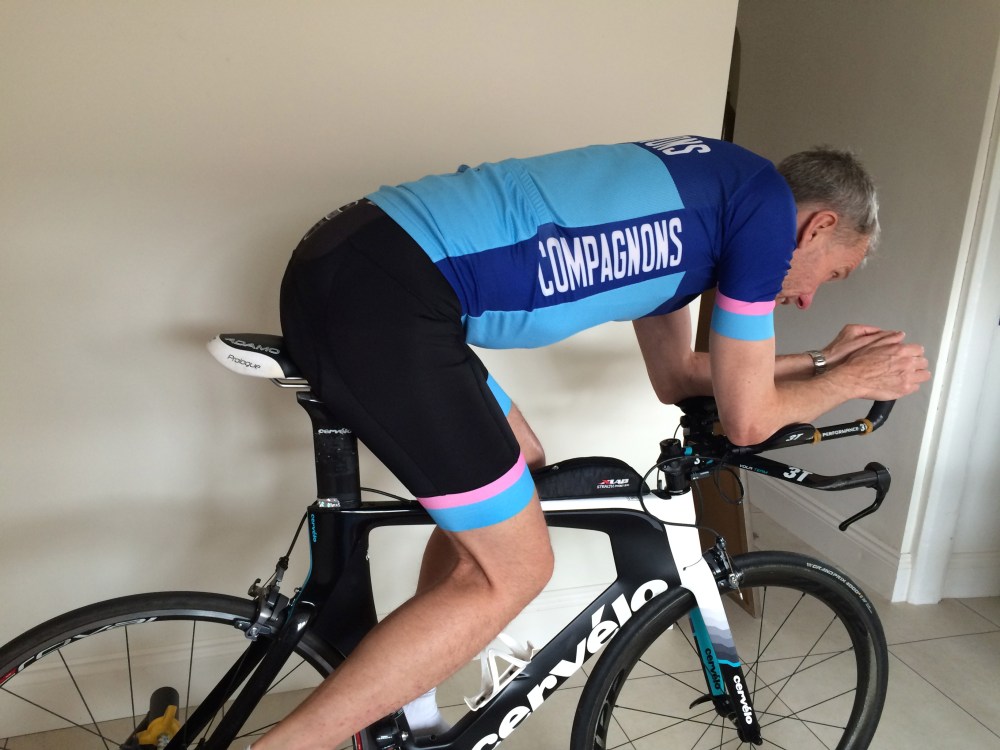
 Was I right to chase that medal or should I have cashed in my chips when I was struggling? A week on I still believe it was the correct thing to do. By the time I knew I was suffering a recurrence of urine retention I would have needed medical intervention anyway. Therefore, carrying on did not compromise my health any further. My brain was telling me to stop, but by carrying on I learnt that my body was still capable of achieving my goal and so the real lesson here is that when I’m healthy again and simply on the edge of exhaustion I know that my body can deliver lots more for me than my brain probably wants to allow.
 Faster after 50