Lessons From Jonkoping 70.3
A week on from my body breaking down during Ironman 70.3 Jonkoping I took my first steps back, albeit gingerly and went for a jog. As I was moving ever so slowly through the beautiful fields behind the church in our village one of my favorite songs floated into my brain. Why did this happen at this moment and what is its significance?:
“Now the drugs don’t work
They just make you worse
And I know I’ll see your face again”
The Verve
As I jogged along I thought about it.
Well, I’ve always been anti drugs of any description and yet since the beginning of 2016 I’ve had to take a daily dose of Tamsulosin, a drug designed to manage my enlarged prostate . One tiny pill each day has not been much of an inconvenience and if it was going to prevent a recurrence of the agony of urine retention then I was prepared to swallow my pride and accept that I needed some outside help to keep my body functioning properly.
But here’s the thing. The drugs don’t work for me and they do make me worse as it appears that a relapse could happen at any time and in my case at the worst possible moment during the biggest race of my year. I’ve suddenly lost my confidence and belief in my body to do what I want it to. This sent me to a very dark place and it took a full week to get to the point where I was even prepared to risk something as simple as a jog.
So I’m determined to find a different solution and not simply accept the acknowledged step one (take the drugs and go away) of the medical profession in the management of this increasingly common middle-aged man enlarged prostate problem. I need to find a better solution for me that recognizes my circumstances and my hopes and dreams. I’ve been doing my own research and as a result I’m seeing a Consultant tomorrow!
By coincidence over the last few weeks I’ve been reading a new book by Matthew Syed called “Black Box Thinking”. Its all about high performance and its key message is that success happens as a result of learning from our mistakes and that the “growth mindset rather than fixed mindset” is absolutely critical for winners. I’ll be blogging some more about this soon as I think it’s a brilliant book with some excellent insights but for now I’ll reference it simply to highlight the importance of learning from each race.
So what can I learn from my experience at Jonkoping?
 Was I right to chase that medal or should I have cashed in my chips when I was struggling? A week on I still believe it was the correct thing to do. By the time I knew I was suffering a recurrence of urine retention I would have needed medical intervention anyway. Therefore, carrying on did not compromise my health any further. My brain was telling me to stop, but by carrying on I learnt that my body was still capable of achieving my goal and so the real lesson here is that when I’m healthy again and simply on the edge of exhaustion I know that my body can deliver lots more for me than my brain probably wants to allow.
I’ve also learnt that health and fitness are not one and the same thing. They are certainly linked but they are very different.
Unlike fitness, health can change dramatically in the blink of an eye and can appear to some to be out of our control. I accept that there are factors of health that are gifted to us good and bad, but I do believe that there is lots that we can do to give ourselves the best chance of being healthy:
- Don’t take it for granted. The fitter you are the better chance you have of being healthy (there is the connection). The doctors in Sweden were astonished at my ability to both deal with the condition that they treated and recover so quickly from their intervention. They recognized that this was down to my fitness levels.
- Take personal responsibility for it. I think I’d abdicated my health to these drugs and assumed because a medical professional had prescribed them then they must be the right answer to my problem. Big mistake.
- Be as informed as you can about anything that is affecting your healthy balance and keep upto date with new developments and research. The wonderful thing about science and medicine is that as a human race we are still learning so much and therefore, GP’s and even Specialists, can not be on top of everything and we mustn’t assume they are.
- No one is as interested and curious about your own health as you and so you must influence it as best as possible by asking questions, encouraging reflection and rethinking. What was the best solution yesterday is not necessarily the best solution tomorrow.
I was guilty of failing to heed most of this insight and my body breakdown in Jonkoping has highlighted just how fragile health is and just how much we need to protect and nurture it ourselves. Given that this blog is all about how to achieve extraordinary things after the age of fifty I think the most powerful lesson I’ve learnt recently is that health is the foundation for success and that it should never be taken for granted.
I have never been fitter. Ever. Period. But without being healthy my fitness can not be put to my advantage.
Moving on, I’ve also learnt that despite my passion for life long learning and development I can have a tendancy to get into a fixed mindset without realising it. For example, over recent races I’ve struggled with my new wetsuit and was beginning to “believe” that it is difficult to remove in a race situation. Anecdotes from other people about Xterra wetsuits being tricky helped to confirm this new limiting belief and therefore I was becoming “fixed” around the wetsuit causing the problem rather than me! It was only through repeated conversations with my coach that I realized I was approaching wetsuit removal in the wrong way. Zip down, Velcro ripped, shoulders out works so much better than Velcro ripped, zip down, shoulders out because if the zip is down first then the Velcro will not reaffix itself as soon as its ripped apart, thus allowing the shoulders to pop out. Consciously following the correct steps resulted in a seamless wetsuit removal and brought a real moment of joy within the hurly burly of the race.
Where might you be limiting yourself with a fixed mindset?
My final piece of learning from Jonkoping is that I got my fueling strategy wrong. I drank too much electrolyte and not enough water on the bike and also took on board too many gels, especially caffeine gels. As a result my body couldn’t process it all and it came back on the run. I did this because after my only other race at this distance I totally bonked with one kilometer to go and so this time I think I went too far the other way. Next time I need to find a better balance.
So despite a deeply disappointing outcome at the race there is so much learning that I can take forward to make me a better triathlete in the future.


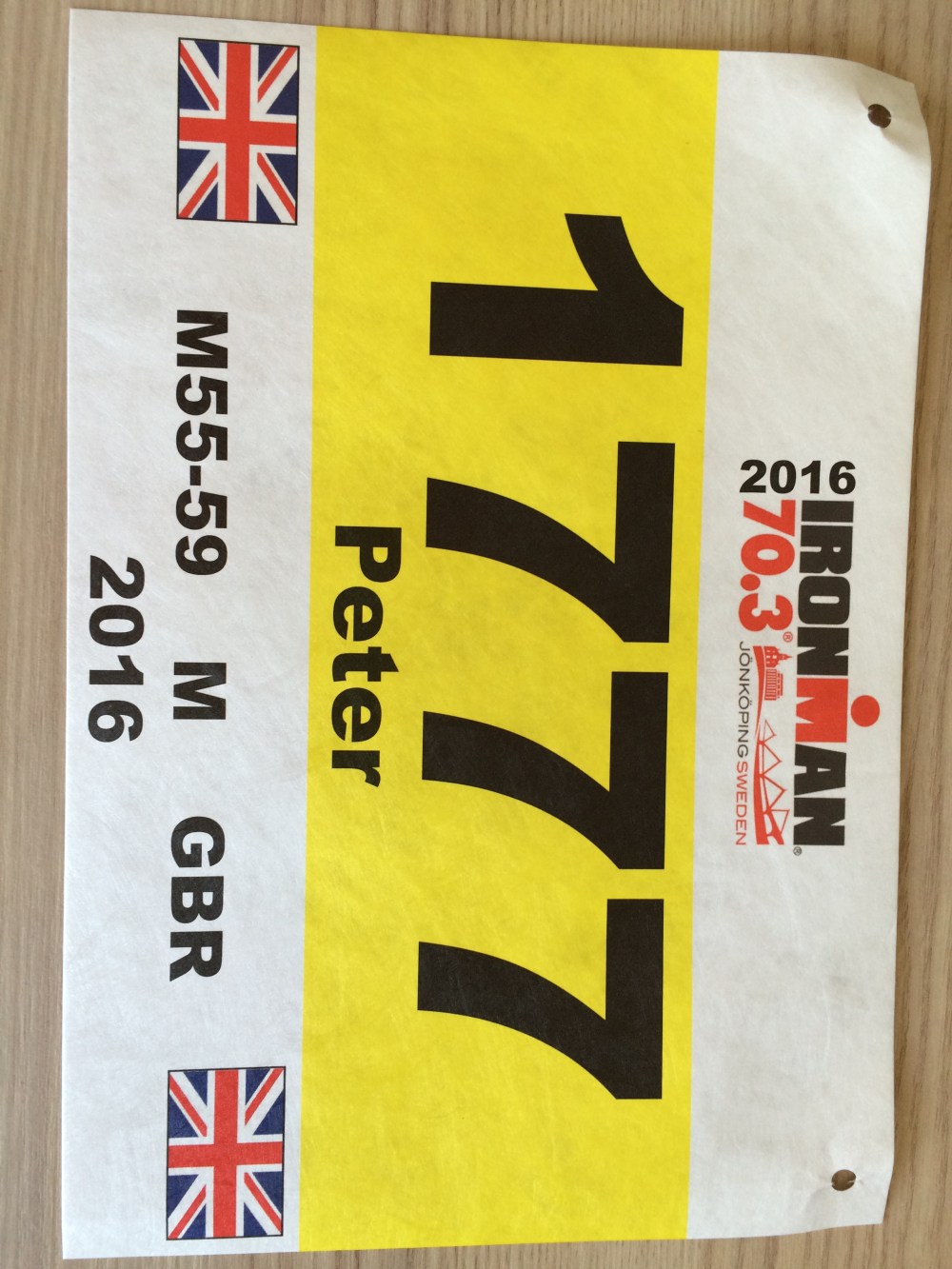 Race day arrived and the conditions were pretty much perfect. It was cool, overcast and the high winds of the previous days had dropped to simply a steady breeze. It was going to be a memorable day.
 A short warm up swim calmed me down and helped get me in the zone for the start. An enchanting rendition of the Swedish national anthem just before the Pro start brought a tear to my eye and reinforced what a special day this was going to be.

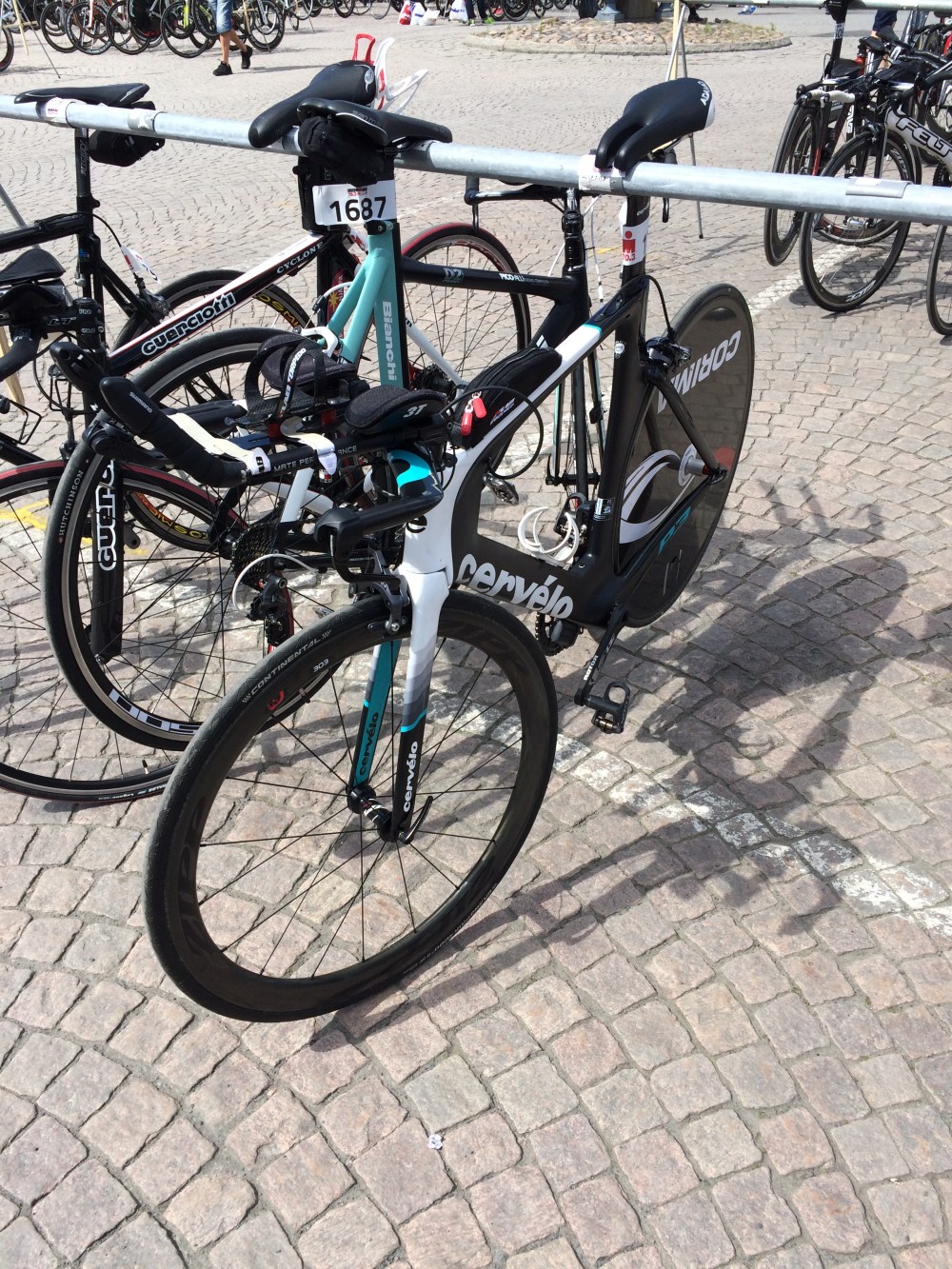
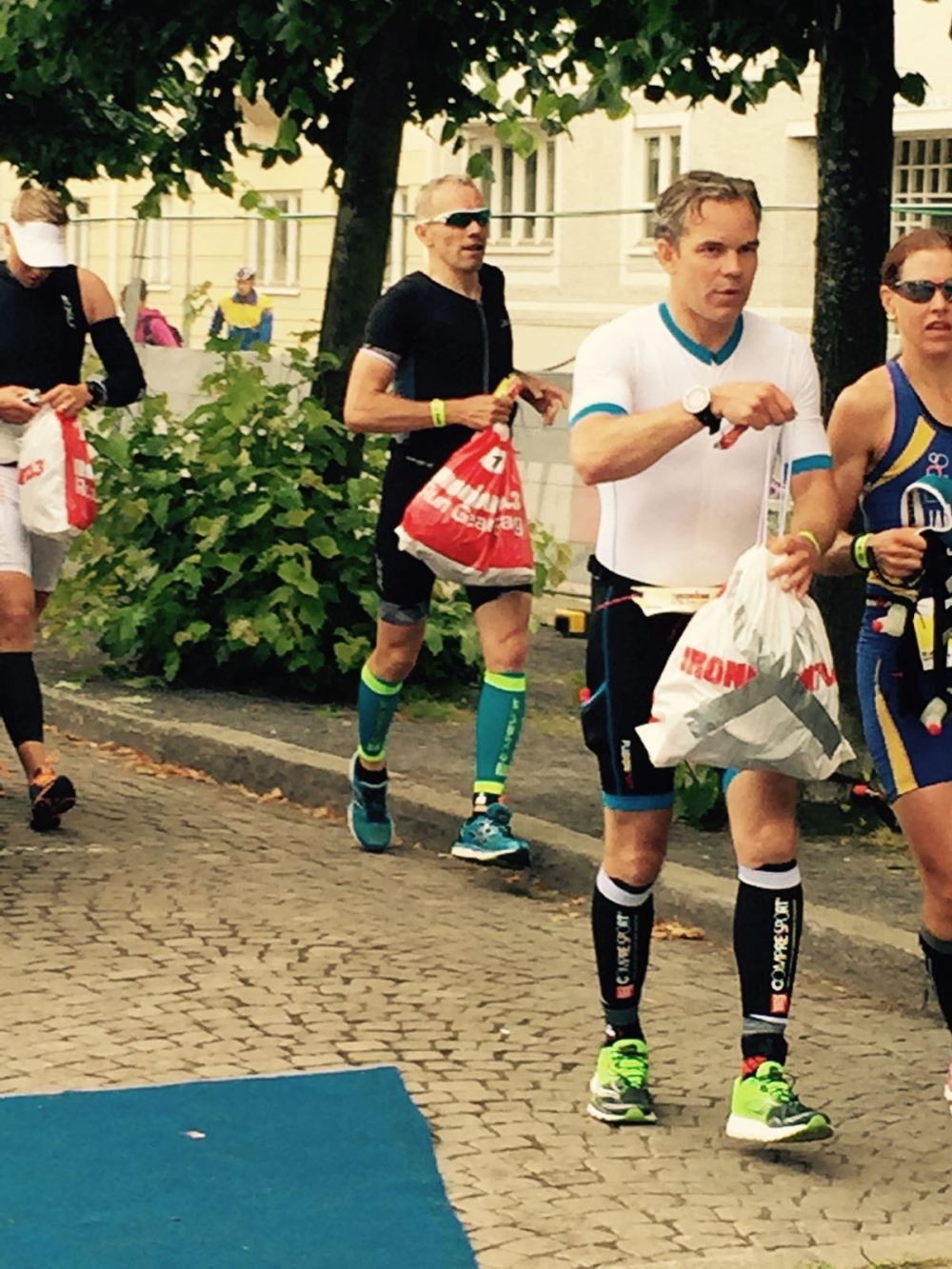 I was pleased to get back to T2 and get on my feet again as I thought this would unlock my ability to pee once I got going. I had a good transition and flew out onto the run course feeling momentarily invigorated. My legs felt great and I thought I was about to put in a strong run. However after 200m I suddenly felt odd and vomited in full stride. It seemed like the gels I’d been taking throughout the bike course had been rejected by my body. My stomach was churning violently and I had to slow down and hang on for the 1st aid station. I made it and felt a bit better after a visit to the toilets but was still concerned that I hadn’t really managed to pee properly. Despite this, I thought that I needed to get some water inside me to help dilute the gel concentrations that were probably still sitting in my stomach. I was now feeling pretty rubbish but concocted a plan to jog between the aid stations and walk whilst taking on bananas and water until i felt better. However, everytime I tried to increase my pace I felt the waves of nausea returning together with an increasing frequency and intensity of the need to pee ( but I simply couldn’t).
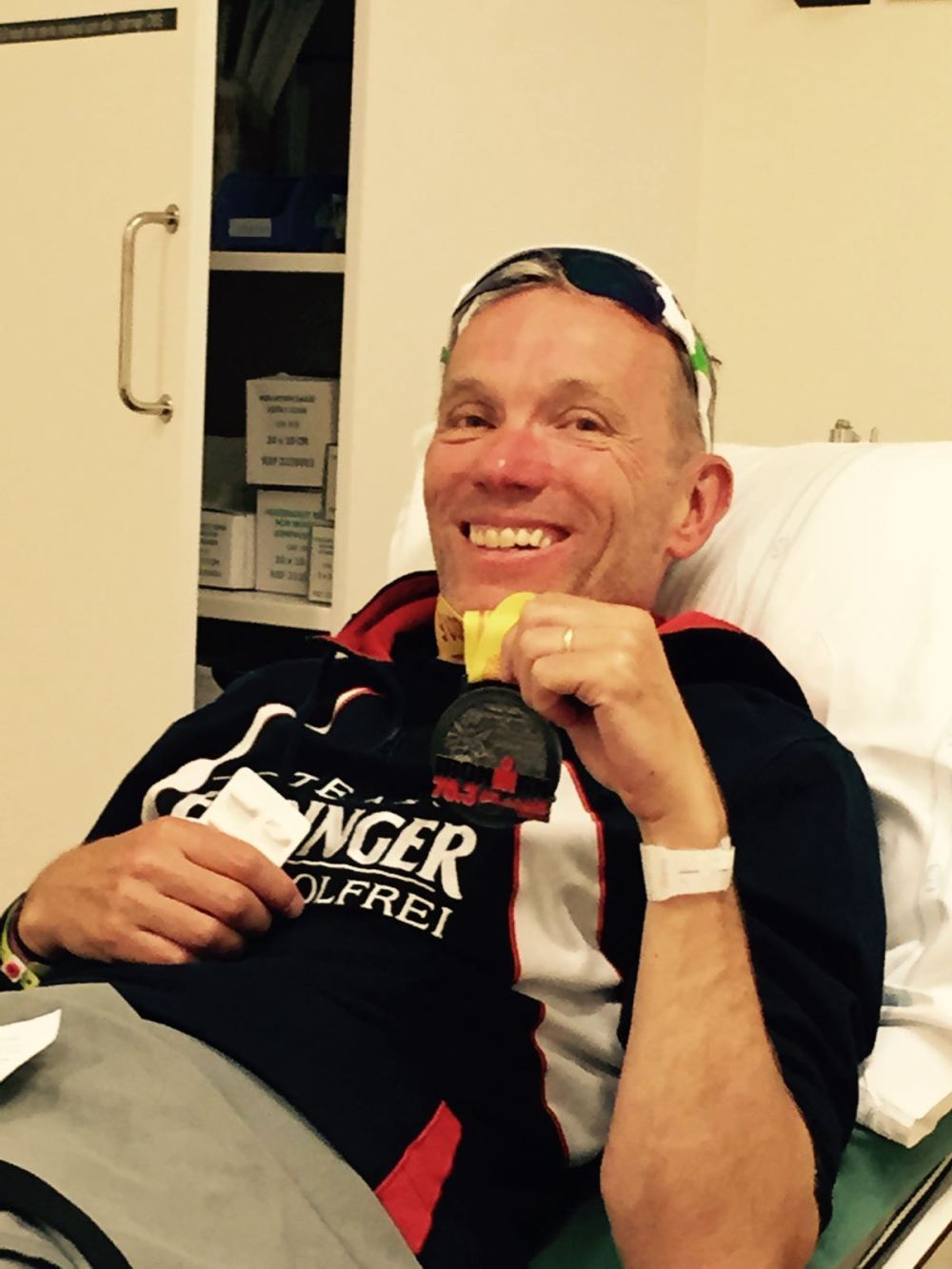 5 hours later, following a series of tests I was allowed to leave, still proudly wearing that Finisher medal. I feel huge gratitude to the whole team who helped me at Jonkoping Hospital.
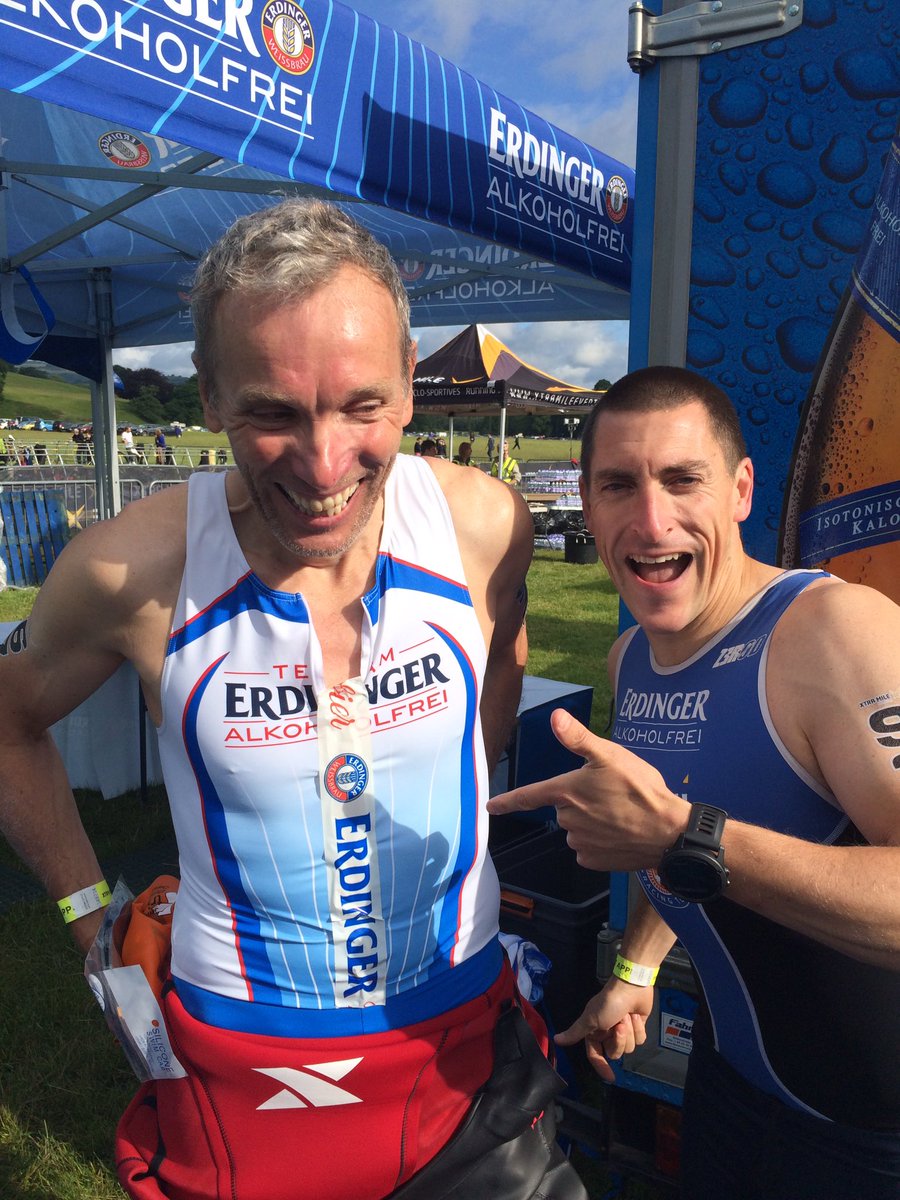 Relieved, I headed off to the swim start arriving just in time for my wave to enter the water. 12 degrees was mighty bracing and the 60 second wait for the start gun seemed like an eternity.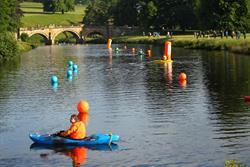
 Faster after 50