Dealing with an Unexpectedly Difficult Period

It’s been a while since I last shared my thoughts.

I’ve found the last few months to be a very difficult period and this has surprised me, especially as I was feeling so positive after my marathon performance in Manchester.

It’s been difficult emotionally and more latterly physically and I’m pretty sure that one has led to the other.

From the outside it would appear as though I’ve been doing really well. I’ve not been injured, I’ve not missed any training sessions, warm up events have gone well and everything seemed to be building towards some outstanding race performances, but that just hasn’t happened yet. There is something not quite right and putting my finger on what, has proved challenging.

When things become difficult I tend to internalise my thoughts’ until i can work out what is going on. My crazy mixed up emotions and thoughts can contradict each other and so I need to allow them to percolate around inside me for a while before it makes any sense in sharing them. I’m now ready, so here goes….


The passing away of my parents has affected me much, much, more than I ever imagined it would. Their deaths were hardly a surprise, with both of them requiring 24 hour care for almost the last two years of their lives. Observing their decline and helping to care for them during this final life stage took much more out of me than I’d expected. My rational self understood that whilst the daily caring might be emotionally tough it does at least it prepare (or I thought it did) you for a future without them. Training everyday gave me the space to process all the emotion and get ready for the next session of caring for them. I really don’t know how I would have been able to cope without the gift of swim, bike and run sessions. When they died I knew they were ready, I knew they were at peace, I knew they had thoroughly enjoyed their lives and I knew they had passed on amazing values to their children and grandchildren. Their work was complete and this helped me to understand, accept and embrace their passing away. I thought I was at ease with it.


So why have I found the months since Mums death so difficult? I’m not quite sure is the honest answer. Maybe, it’s something to do with the responsibility of dealing with their will and tying up all the loose ends of their lives? I’m not good on admin at the best of times and this feels like an administrative task that is designed to file them neatly away. Hence I’m struggling with it.

How do you deal with a pair of lifetimes that have now ended? Why do we have to put a monetary value on it and create a set of “estate accounts” that summarises their lives? Surely it’s about more than this? Their home for the last 55 years, full of possessions accumulated along the way, nothing ever discarded because you “never know when it might be needed”, has had to be dealt with. How do you decide what to do? Some things have sentimental value and will be kept and distributed amongst the family as prized memories. That’s the really positive and rewarding part of this responsibility. Other things can be taken to the tip because they were never needed again (surprise surprise) but with a bit of luck they may get recycled. Wardrobes full of clothes can be taken to charity shops and may prove useful to others. Again there has been something mildly satisfying about these two functions. Then there is a whole mass of other stuff that has helped to define and colour their lives and makes the important difference between a house and a home. All the things from furniture, ornaments, bits and pieces that they accumulated along their journey, every piece chosen for reasons that will never now be known. Everything they possessed was hard earned and so they didn’t make any purchase decisions lightly. Whilst some of this stuff would still have been useful to them for the next twenty years it now seems that it has become redundant. When these things are taken out of the setting of the home they simply become a random collection of odd things. Its value to the world is seemingly minimal and yet to them it was priceless. Should I really be making the choice between a charity shop and ebay for the things they worked so hard to possess? Is that really all dismantling their home has come to? I realize I’m over thinking all this but maybe its part of my grieving process….certainly getting it all down in this blog is helping me to identify what has been going on in my subconscious.


Another factor in my emotional struggle recently has been the question of what next. We moved our lives three years ago to be close to my parents to help them adjust to a less independent lifestyle. This is now over and so we can choose to do something else and choose to go anywhere we like. Now that my parents have gone we feel that we want to move on and so we have spent lots of time discussing all the places we might like to move to. This is exciting, but also destabilizing at the same time. I think I’m realizing that unlike in the Paul Young song from 1980’s wherever I lay my hat is not really my home. I think I do need to have a physical base that I can call home in order to function at my best. Our decision to move on is crystalising for me that Chester is not going to be home, nor is Windsor where we brought up our boys but moved on from 3 years ago. So where will our home be? It’s too early to say yet but I know we’ll find the right place and when we find it, it will also prove to be the springboard for a new business venture for us both to share. That’s really exciting but currently not knowing where is proving a distraction to my current goals in middle distance racing as it destabilizes me when something doesn’t go to plan.


For example, my first A race of the year was two weeks ago in Sankt Wendel Germany. It was the European Middle Distance Duathlon Championships. Last year I performed really well and picked up the bronze medal for 3rd place in my AG and going into this years race I thought I was on top form. I’d had a really good block of training following on from my marathon achievement in April and I really believed I was ready for another outstanding performance. But it just didn’t happen.


The first run went perfectly to plan. I managed my effort faultlessly around two laps of what was a brutal run course and came into transition in 3rd place with two Dutch guys exactly where I wanted them. I thought I would be stronger on the bike and so would be able to build up a lead that would give me half a chance of holding them off on the 2nd run. However, to execute that plan I needed to bike well and deliver the power numbers that I knew I was capable of holding over the 60 km leg. To prevent me from going too hard up the climbs I knew the power number to stay below but frustratingly I couldn’t get anywhere near this number. I just didn’t feel right on the bike that day. My legs struggled to find the power and strength that was required. Over the first two laps I did at least manage to hold a respectable, if below par, level of output on the bike but as I went onto the climbs for the third lap my legs just died. I was suffering badly and almost cramping with the effort I was putting in to produce such a reduced level of power.

I couldn’t understand it as I had taken on board lots of fluids and fuel so I couldn’t be dehydrated or empty. Had the hills just sapped my strength more than I’d imagined they could?

I went out onto the 2nd run in 3rd place. A German guy had passed me on the bike and I’d got past one of the Dutchmen. The first part of the run lap was ok as it was slightly down hill but then I hit the hills for the first time. Bang, I could hardly lift my legs to keep them moving. My quads went into cramp immediately so I had to stretch and then walk. I was suffering, but determined to keep pressing on. It wasn’t long before the Dutch athlete came past and at that point I realized my medal hopes were gone. I just couldn’t get up those stinging hills to stick with him and on the way back down I had to be even more careful as my hamstrings were ready to pop into cramp if I went too quickly. I kept going and have taken a huge positive from the race that I did not become at all negative about my performance whilst I was in the middle of it ( I have certainly given myself an unnecessary and unjustified kicking about it since the race though!). I didn’t need to remind myself about how lucky I was to be doing this, I simply maintained focus on the task in hand which was to get to the finish as quickly as possible and I still managed a huge smile as I crossed the line in what proved to be 4th place. I was proud but hugely disappointed at the same time. I felt I was in shape to win a medal but for some reason I just couldn’t deliver on the bike and then suffered even more on that final run. I did under perform. It’s certainly not about fitness, but maybe I just wasn’t strong enough to take on such a brutal course. Or maybe it was one of those mysterious days that I hear elite cyclists talk about when they just didn’t have the legs? Or maybe, and this is what I believe its much more about, it was something to do with all of the stress I’d been unknowingly carrying since the funeral? Maybe the mental fatigue that is stress, converted itself into physical fatigue.

I now recognise that 4th in Europe is a great achievement, but with Jake, my eldest son alongside me for this race I so wanted to win a medal as I misguidedly felt that this would cap a really special weekend together. I now realise that I’d been unconsciously putting way too much emphasis on the result of this race whereas the really important thing to value is that we had a fabulous 5 day road trip together.

When I finished the race I knew it was the hardest course I’d ever competed on and the physical punishment that it created was still evident a week later. I normally bounce back pretty quickly but it took a week before my legs felt like they belonged to me again and almost two weeks on I’m still not feeling as though I’m executing my training sessions at the levels that I should be reaching. I think I can be assured that I pushed myself to the max in Sankt Wendel and have no regrets that I could have given more!

Ultimately all you can ask of yourself is that you gave it your best and this I certainly did. It didn’t work out how I wanted and I’ve accepted that it’s ok. Importantly, it’s not going to derail me from working towards the rest of my goals for this year and the next two years. I heard a helpful comment from Dave Brailsford of Team Sky after the Giro D’Italia finished when he said that what he’d learnt from the race was that even when things go wrong, if you keep knocking on the door and doing the right things then eventually the door will open and you will get your deserved reward. That’s exactly what I will keep doing, knocking on the door.


It’s now a triathlon door for the rest of the year, beginning this weekend with one of my favorite races, Deva Triathlon in Chester. It’s such a beautiful setting with the river swim and the natural arena of The Groves for the climax of the run. Lets hope this inspiring setting can kick me out of the lethargy I’m feeling and get me firing again towards my next A race in Denmark in a few weeks.


I’ll let you know how it goes.

Reflections from Manchester 48 hours on

I woke up this morning, now 48 hours on from the marathon, still basking in that warm glow of satisfaction having dealt with my demons and delivered a perfectly executed plan in the race.

The recovery swim and bike sessions from yesterday have done the trick and my legs are feeling much better already. I feel that I’m well on the way to recovering from the battering that the marathon inevitably gives the legs.

I’ve recently been doing some work with one of my clients about what it takes to be a winner and the thing that stands out amongst many success factors is the focus that these winning people have on looking forward. As soon as a victory has been secured they are onto the next thing. Every success is simply a stepping stone towards the next goal.

So I was fascinated to notice that whilst I was in the pool and on the bike yesterday my mind started to whirl again. “I wonder how much faster I really could run the marathon in the future?” Clearly a new goal is forming in my head as I now believe that more is in me than I dared to imagine only a few days ago.

Before moving on though, its important to learn a few lessons from what happened on Sunday. Why did the race go so well? As this blog is all about inspiring the achievement of extraordinary things I thought it may be useful to share why and how I believe I achieved my own extraordinary thing in Manchester.

A huge part of endurance sport is mental. I’ve talked at length about my marathon demon of self doubt that has been festering for many years and it was so important that I’d dealt with it ahead of race day. Standing on the start-line hoping it would be ok is not a recipe for success. For me, having a very explicit conversation about my concerns and doubts with someone that I trusted and whose opinions I valued on this subject was a key step. This conversation clarified that there was much more evidence against the limiting belief that “my body can’t cope with the punishment of a marathon” than there was to support it. As a result of that conversation with Annie I was able to go through a process of reframing for myself. Here are just some of the facts that I used in that exercise to rid my brain of the demon:

  • I am now an experienced endurance athlete
  • I regularly complete and succeed at equally/more demanding events than the marathon
  • I have been clocking up some huge weeks of tri training since the beginning of 2017
  • I have been bouncing back really well from some heavy sessions

I used these facts (importantly, not opinions) to form a new positive belief that I took with me to the start line: Tri training is the best way to prepare my body to perform a marathon.

With this inspiring thought firmly positioned at the front of my head I then set about creating a plan for the race. There is that old saying that “failing to prepare is preparing to fail” and nothing could be truer in relation to the marathon.

You have to go into the race with a very clear plan of what you want to happen. This plan needs to be controllable. Mine looked like this.

  • Go into the race well rested, hydrated and nourished. Eat lots of green veg, good carbs and fats, plus protein during the days leading upto the race. Eat a bowl of my favorite bircher 3 hours before the race. Sip on water with electrolytes during the last few hours pre race.
  • Be disciplined to run an even paced race, know exactly what the mile splits need to be and ensure you don’t get carried away with the euphoria of the early stages. Adjust your pace, even if it feels too easy.
  • Be disciplined about hydration and nutrition. Take advantage of every water station so that you are drinking little and often. Take on board a gel after 45 minutes and then one every half an hour from then on. This keeps the energy levels topped up and avoids hitting the dreaded wall.
  • Stay in the moment. Soak up the atmosphere. Enjoy what is going on around you right now. Avoid thinking ahead. Allow thoughts to appear and drift away again. Consciously run through a technique checklist every mile or so to ensure you remain relaxed. Think hands, arms, shoulders, head, core, foot placement. Relaxation is key.

That was it. There was a physical, mental and nutritional aspect to it. Keep it that simple. Have a plan that is realistic and controllable, and then during the race all you have to do is execute it. However, just because its simple doesn’t make it easy. That in a nutshell is the challenge of the marathon!

This time I was able to execute the plan almost perfectly because I understood what was within my control and I remained focused on the 3 dimensions of it throughout. Also I was fortunate that nothing outside of my control affected me. Sometimes this happens and if so we need to accept it and adjust the plan accordingly.

Reflecting on why things went well is powerful learning for me and I’ll take this forward into my next set of challenges. I hope it can be helpful to others too.


Lessons From Jonkoping 70.3

A week on from my body breaking down during Ironman 70.3 Jonkoping I took my first steps back, albeit gingerly and went for a jog. As I was moving ever so slowly through the beautiful fields behind the church in our village one of my favorite songs floated into my brain. Why did this happen at this moment and what is its significance?:

“Now the drugs don’t work

They just make you worse

And I know I’ll see your face again”

The Verve

As I jogged along I thought about it.

Well, I’ve always been anti drugs of any description and yet since the beginning of 2016 I’ve had to take a daily dose of Tamsulosin, a drug designed to manage my enlarged prostate . One tiny pill each day has not been much of an inconvenience and if it was going to prevent a recurrence of the agony of urine retention then I was prepared to swallow my pride and accept that I needed some outside help to keep my body functioning properly.

But here’s the thing. The drugs don’t work for me and they do make me worse as it appears that a relapse could happen at any time and in my case at the worst possible moment during the biggest race of my year. I’ve suddenly lost my confidence and belief in my body to do what I want it to. This sent me to a very dark place and it took a full week to get to the point where I was even prepared to risk something as simple as a jog.

So I’m determined to find a different solution and not simply accept the acknowledged step one (take the drugs and go away) of the medical profession in the management of this increasingly common middle-aged man enlarged prostate problem. I need to find a better solution for me that recognizes my circumstances and my hopes and dreams. I’ve been doing my own research and as a result I’m seeing a Consultant tomorrow!

By coincidence over the last few weeks I’ve been reading a new book by Matthew Syed called “Black Box Thinking”. Its all about high performance and its key message is that success happens as a result of learning from our mistakes and that the “growth mindset rather than fixed mindset” is absolutely critical for winners. I’ll be blogging some more about this soon as I think it’s a brilliant book with some excellent insights but for now I’ll reference it simply to highlight the importance of learning from each race.

So what can I learn from my experience at Jonkoping?

IMG_0685Was I right to chase that medal or should I have cashed in my chips when I was struggling? A week on I still believe it was the correct thing to do. By the time I knew I was suffering a recurrence of urine retention I would have needed medical intervention anyway. Therefore, carrying on did not compromise my health any further. My brain was telling me to stop, but by carrying on I learnt that my body was still capable of achieving my goal and so the real lesson here is that when I’m healthy again and simply on the edge of exhaustion I know that my body can deliver lots more for me than my brain probably wants to allow.
I’ve also learnt that health and fitness are not one and the same thing. They are certainly linked but they are very different.

Unlike fitness, health can change dramatically in the blink of an eye and can appear to some to be out of our control. I accept that there are factors of health that are gifted to us good and bad, but I do believe that there is lots that we can do to give ourselves the best chance of being healthy:

  • Don’t take it for granted. The fitter you are the better chance you have of being healthy (there is the connection). The doctors in Sweden were astonished at my ability to both deal with the condition that they treated and recover so quickly from their intervention. They recognized that this was down to my fitness levels.
  • Take personal responsibility for it. I think I’d abdicated my health to these drugs and assumed because a medical professional had prescribed them then they must be the right answer to my problem. Big mistake.
  • Be as informed as you can about anything that is affecting your healthy balance and keep upto date with new developments and research. The wonderful thing about science and medicine is that as a human race we are still learning so much and therefore, GP’s and even Specialists, can not be on top of everything and we mustn’t assume they are.
  • No one is as interested and curious about your own health as you and so you must influence it as best as possible by asking questions, encouraging reflection and rethinking. What was the best solution yesterday is not necessarily the best solution tomorrow.

I was guilty of failing to heed most of this insight and my body breakdown in Jonkoping has highlighted just how fragile health is and just how much we need to protect and nurture it ourselves. Given that this blog is all about how to achieve extraordinary things after the age of fifty I think the most powerful lesson I’ve learnt recently is that health is the foundation for success and that it should never be taken for granted.

I have never been fitter. Ever. Period. But without being healthy my fitness can not be put to my advantage.

Moving on, I’ve also learnt that despite my passion for life long learning and development I can have a tendancy to get into a fixed mindset without realising it. For example, over recent races I’ve struggled with my new wetsuit and was beginning to “believe” that it is difficult to remove in a race situation. Anecdotes from other people about Xterra wetsuits being tricky helped to confirm this new limiting belief and therefore I was becoming “fixed” around the wetsuit causing the problem rather than me! It was only through repeated conversations with my coach that I realized I was approaching wetsuit removal in the wrong way. Zip down, Velcro ripped, shoulders out works so much better than Velcro ripped, zip down, shoulders out because if the zip is down first then the Velcro will not reaffix itself as soon as its ripped apart, thus allowing the shoulders to pop out. Consciously following the correct steps resulted in a seamless wetsuit removal and brought a real moment of joy within the hurly burly of the race.

Where might you be limiting yourself with a fixed mindset?

My final piece of learning from Jonkoping is that I got my fueling strategy wrong. I drank too much electrolyte and not enough water on the bike and also took on board too many gels, especially caffeine gels. As a result my body couldn’t process it all and it came back on the run. I did this because after my only other race at this distance I totally bonked with one kilometer to go and so this time I think I went too far the other way. Next time I need to find a better balance.

So despite a deeply disappointing outcome at the race there is so much learning that I can take forward to make me a better triathlete in the future.

Race Report. Aviles, Spain. June 5 2016. World Duathlon Championships

Race day arrived and I woke having slept relatively well, which I interpreted as a good sign. I felt calm and ready. It was almost time for the big test of the World Championships again. A pre breakfast jog confirmed that my legs were ready to race. No heaviness or fatigue. “Steal springs” perhaps, but I’d be deluded if I felt I’d be able to run at the speed of a leapord like that character in Gallipolli….maybe a 57 year old leopard though!

Our taxi arrived on time and he found his way around all the local road blocks easily, delivering me to the race start area in good time. All the variables that were out of my control were now behind me. Everything was going well. Surely it was going to be a brilliant day.

I checked my bike in transition, pumped up tires, fitted bike shoes and my set up was done. Warm-up was completed and I was ready to go. The usual nerves started to kick in as we were called to the holding pens but it was excitement rather than fear that I was feeling.

13391572_10154248040584868_1827367328456479881_o

13403963_10154248041704868_5048427689201245867_o

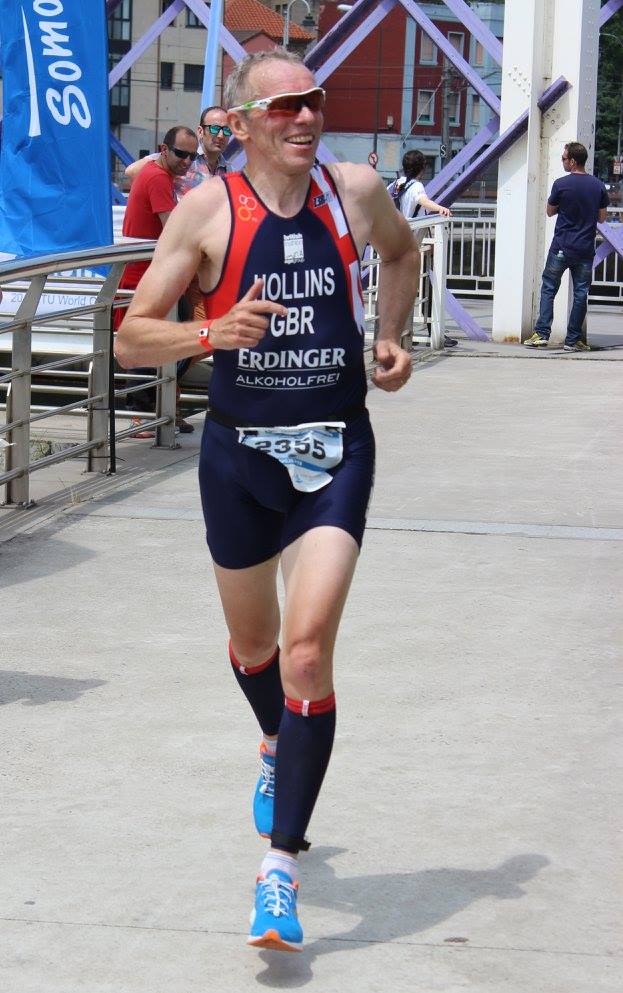
The start gun fired and we were off. I felt alive and the huge crowds were inspiring as we ran through the main arena and out alongside the river. My stride pattern was good and it felt like I was running well but I think in the excitement of the event I went off a bit too fast, even though it didn’t seem that way at the time. After the first half lap (of two) a number of guys in my AG started to come past me and by the time we had reached about 8k I was down in 12th/13th place. This was not where I’d expected to be, but ok, I’ll have to fly on the bike to get back into contention.

IMG_0075During the last 2k back to transition I worked hard to hold my position and keep calm. Once I got out onto the bike I felt great. I got into my rhythm really quickly and began reeling in the faster runners. By the time I reached the foot of the one hill on the course after approximately 10k I had two quick Americans in my sights. I went past them with relative ease and felt this surge of excitement. I was now definitely back in the race and over the next 30k I could really impose myself. Down the other side of the hill I went, taking a moment to recover and then I noticed one of the Americans come past me again. Rather than letting him get into the sharp corner at the bottom first, I stupidly decided I wanted to show him who was in control and I pushed on and took a more aggressive approach into the corner.
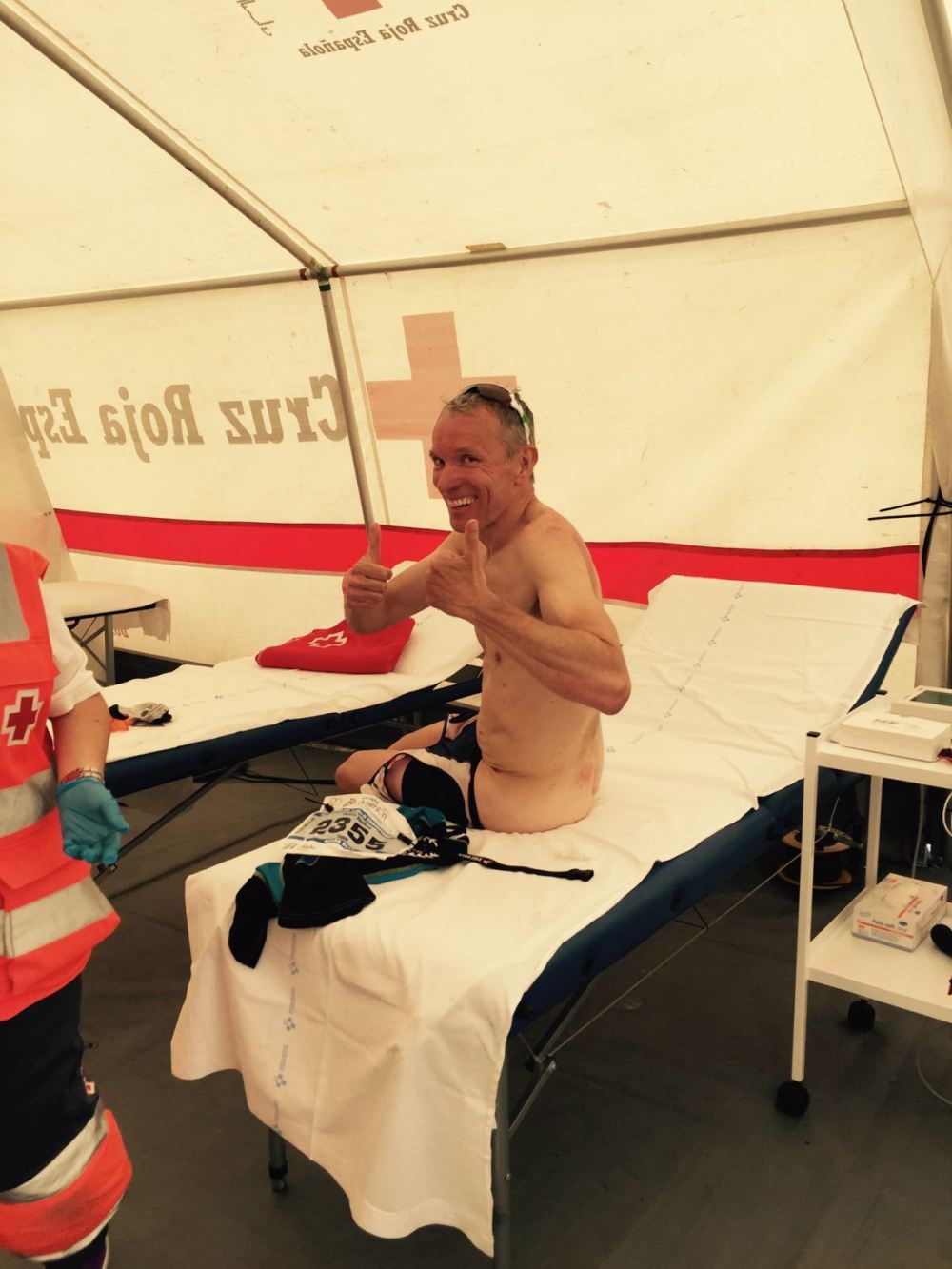
Instantly I realized this was a mistake. I was coming into the corner too quickly and hadn’t given myself enough room. I hit the brakes hard to take some speed out before I needed to turn, but I hit them too hard, the wheels locked up and I was sent head first over the bars. I think I hit the ground first hard on my right hip and then somersaulted forward on my back before springing pretty much straight up onto my feet. At some point in this action my shoes came free from the pedals and the bike went in a different direction and thankfully didn’t cause anyone else to crash. I would have been even more disappointed if I’d ruined anyone else’s race.

My world stopped for a second or two. The huge crowd gathered at this corner took in a collective deep breath. I was dazed, confused, in a state of shock. I couldn’t understand what had happened and was frozen to the spot. As I turned around and saw my bike the crowd began to cheer. It was lying in the road and I went over and picked it up. The wheels seemed to be running freely. The handle bars seemed straight and aligned properly. The drivetrain was intact. The bike seemed ok.

My body was screaming in pain, especially my hip and back but I instinctively got back on and started gingerly peddling away. With this, the crowds went crazy. Under the direction of the local PA system they started chanting my name. “Hollins, Hollins, Hollins” was ringing out right along the waterfront and I was overcome with emotion as I slowly rode away, confused about what happened and what to do next.

My first thought was that my race was now over. I couldn’t get back into contention after such an horrific crash and so I’d ride back to transition to retire. A motorbike came alongside me and the rider was concerned for my health. He tracked me for a few minutes before I reassured him that I was ok to make my own way back. I then remembered I had a gel on the bike and so I took it. This helped to calm me down and as I slowly rode the 7k back towards transition I took my awareness around my body, checking out the physical situation. Apart from my hip that was thumping with pain, the rest of the body seemed ok. Only a few months ago, id experienced a similar hip pain on the left side ( another bike crash!!) and knew that riding hadn’t caused any further problems on that occasion. So my thinking began to change. I decided to complete the bike course and then see how I felt when I tried to run. Its not everyday you have the honour of competing in a world championship and so I wanted to give my all.

I set off on lap two, with a view to simply enjoy the rest of the race. I might not win but I was going to relax and soak up the awesome atmosphere that was being generated by the combination of team supporters and locals who were out in their thousands to cheer on the athletes. Once I relaxed, I found I was riding strongly again and soon began overtaking lots of other competitors. As I approached the infamous corner on the second lap I went into it much more cautiously. To my surprise the crowd recognised me instantly and the cheering and chanting  “Hollins, Hollins, Hollins” began again. I was overwhelmed by their support for me and this certainly endorsed my decision to continue. I pushed on further. By the time I approached T2 I could see that I had re caught a number of guys in my age group that I had overtaken prior to crashing out. This gave me a renewed sense of purpose. I was going to finish, even if it meant walking the last 5k. The moment of truth arrived at the dismount line. Was I able to run? Good news, the pain through my hip did not stop me from running and so I went through the long transition with the bike, changed into my run shoes and set off.

As I came out of T2 I saw Kathy and decided to tell her that I’d crashed just in case she was concerned about why I’d been so long on the bike. The fact that I was running should reassure her that I’m ok, was my reasoning.

13416880_10154248050004868_541030207145427527_o

I took it easy over the first kilometre or so and then realised that I was running ok and so pushed on. I think my 2nd lap was quicker than my 1st and as I ran back towards the finishing arena I could see a number of athletes ahead. I began to pick them off and managed to overtake at least one guy in my age group.

I crossed the line feeling hugely proud that I’d battled on to finish the race despite the crash. I thought I would perhaps finish in the top 15 after all the time I lost, so was totally chuffed to discover that I finished 8th. A top 10 finish in the world championships after crashing is probably as good a performance as in any previous championships when I’ve been lucky enough to win medals…..and its certainly a performance that I’ll never forget!

IMG_0067

What did I learn?

Its crucial to stay calm and “in the present” at all times when racing. I allowed myself to get overexcited by the fact that I was reeling in those competitors in my AG that had run faster than me. In less than 10k I’d gone past at least 6 and knew that I was capable of putting myself into a medal position by the time I got off the bike. However, I made a huge error and took too much of a risk going into that corner. I knew the corner was there, I knew it was a tricky one to negotiate and yet I simply failed to give it the consideration it deserved because I wanted to get through it ahead of one of my American rivals. The reward for doing this would have been negligible and given I’d already made up more than 30 secs on him in 10k, I was surely going to put much more time into him over the next 30k of the bike leg. But in the heat of the race, I didn’t think straight and was too aggressive going into that corner.

So the 2nd bit of learning is about risk-reward. The rewards for taking risks need to be significant to even consider taking them. If not, back off.

And finally. It’s never over until it’s over. To get 8th place finish, less than 1 minute behind 5th after all the time lost and the damage done seems pretty remarkable and acts as proof to me that I should never give up.

I’m going to take a week off racing now and give myself time to recover properly before building up to the next biggie of the season which is a trip to Sweden for Jonkoping 70.3 in July.

My thanks as ever to my amazing wife Kathy for her love, support, patience and selflessness. Also big thanks to everyone in Aviles and ITU involved with organising this wonderful event, Jez Cox and his team, plus the whole of the GB team for creating such a wonderful team spirit.

Listening to the body is key to learning the ability to adapt

It’s been a challenging week, but such an important one as I’ve learnt more new lessons that I hope I can hold onto as I continue to develop as a triathlete.

I woke up on Monday morning feeling rubbish and for a couple of days continued to go downhill physically and mentally. I was struggling with an overwhelming lethargy, a grogginess as I wasn’t sleeping well, an aching body and a sense of not been in focus. Everything was fuzzy and the physical niggles that I’ve been dealing with in my right hip and left achilles just suddenly seemed to be much more intense (they weren’t, it just felt like it).

Now, over the weekend I’d decided that this week was going to be a big training week. I’d recovered (or so I thought from Windsor) and with no business deadlines to get in my way I was going to focus on putting together some strong training as I build up to the next part of the season which is going to be about racing longer. So waking up feeling rubbish wasn’t a great start. Not being able to put a label on it made it more difficult for me to accept that there was some real going on and that I wasn’t just making an excuse to forgo training.

Unlike the normal me, I made the smart decision, took the day off and replaced training with rest but this only seemed to make things worse. A chat with Coach Annie the next day helped and she reassured me that taking a few more days to let my body heal itself was what I needed. Now, getting Coach’s approval to ease back is crucial for me to get my head right and in doing this it freed me up to reframe the way I saw the week. I was still going to train hard but rather than these sessions being swim, bike, run sets my training was now going to be based around lying down, stretching, foam rolling, reading. The time I had planned for training was still going to be used but in a different way.

One of the things I read was this brilliant article by Brett Sutton and it really resonated with me. http://trisutto.com/?s=ability+to+adapt

Brett really understands the Age Grouper psyche and in his article he identifies the very common challenge for successful people of juggling multiple important balls that include career, family, friendships, sport. (Maybe its part of the appeal of triathlon that it involves yet more juggling). We do often fall victim to the delusion of wanting it all,  thinking that we can fit it all in and that is probably the driver behind the 3.30am turbo session that Brett alludes to. He is quite right to point out the madness of it as it will have a negative impact down the line. We probably all know this, but need reminding of it so that we can change our behavior when its getting out of control. Hence the importance of a coach.

However, there is something else that is going on inside the Age Grouper psyche, I think, and this relates to the misguided view that we are supposed to be superhuman. Our contemporaries and colleagues admire us for our energy and invincibility and therefore we are not supposed to have bad days at work, at home, at play. We are not allowed to have days when we are off colour. We are supposed to set an example.

The dreaded “Man flu” is one thing and being injured is part “badge of honour”, part “comes with the territory”, but having a non specific sense of not being right is seen as not an excuse for not continuing to live our lives at 100 miles an hour, 24/7.

And that’s where we get it wrong. We wont be super humans unless we listen to our bodies and know when we are in danger of tipping ourselves over the edge.

There is a difference between the pleasurable fatigue the body knows when it has put in a block of hard training and the sense of lethargy, the aching deep in the bones and the general weariness that are signs that we are putting ourselves in danger. We need to learn to recognize this difference. If we can, then we will know when to step back and adapt and we can work towards being super humans rather than chasing the madness of superhuman status.

So, to build on Bretts mirror conversation. Lets really take a look long at that person reflected in the mirror and ask “what is my body telling me today and do I need to adapt my training ?”

By replacing swim bike run for a few days with lie, roll, stretch I’m now really alive again and enjoyed a lovely run along river this morning.

Long may I continue to listen to and trust in what my body is telling me!

Thanks Annie, thanks Brett.

72 hours on: Reflections from Windsor Duathlon

I thought I should follow up from Sundays Windsor Duathlon race report with a few reflections now that I’ve had a couple of days to process the event.

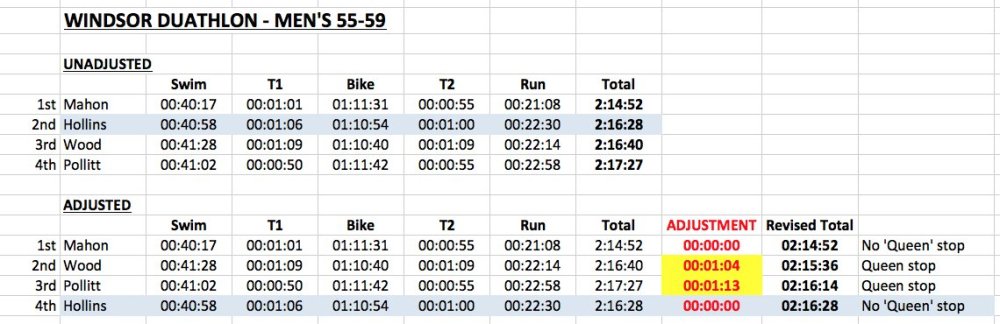
But first I would like to congratulate all the medalists from Sunday and especially Messrs Mahon, Wood and Pollitt who won the medals in the Mens 55-59 AG. Duncan Wood and Martyn Pollitt dealt with the disruption of being held up mid race brilliantly to come back and finish really strongly, thoroughly deserving to win their medals, thus knocking me out of the top 3 in the process. Here is the revised result:

lzw2p0Wz

Now, when I crossed the line I was wonderfully knackered and experiencing that sense of exhaustion that comes from really testing yourself to your physical limits. It’s a pretty euphoric sensation and it can tend to distort your view of what’s real. When things have gone well then the feeling is total elation and when things have not gone to plan then the world can feel like its about to come to an end. Neither is rarely true even if it absolutely feels that way in the moment. But on Sunday I was experiencing a mixture of confused emotion. I thought I’d won a medal, which gave me such a high for several hours, but on the other hand I knew I hadn’t quite nailed the performance and at that time I was ready to blame external factors.

With the benefit of 72 hours to reflect, to gather more information relating to the results confusion and importantly to offload the unhelpful feelings I was experiencing, I’m now in a mental place to learn from the event.

Reflection is such a powerful performance tool as it can help to identify the important factors that have impacted on an outcome such that they can be built on or changed the next time, or if they are out of your control then they can be forgotten about.

The controllable factors for me from Sunday were:

  • Dealing with the conditions: I got most of it right in that I stuck to my normal transition bike set up routine but I should have carried the bike out to mount line “cyclo-cross style” to get my bike leg off to a faster start.
  • Dealing with my chimp factor: since my Gran Canaria camp with TriSutto I’ve been wrestling with what to do about my bike as its too small and I’m now just waiting for the new bike to arrive. In the meantime I should have been much more relaxed about the bike and used my past performances as evidence that I can ride strongly on it. Instead I think I was looking out for any indications that reinforced the negativity I’ve been feeling and on the first lap I found lots of examples to get my chimp agitated. This definitely cost me time on the bike.
  • Avoiding distractions on run two: as I get tired I must continue to focus on what enables me to run well and not get distracted by such things as the race commentary, the pace of others, what might be ahead etc. I need to stay in my bubble where I know what to do and how to get the most out of myself. On Sunday I forgot all this!
  • Run hard until the end. Ultimately its about getting the most out of yourself and if you do this then the result will take care of itself. I found myself scanning the other runners to see who was coming from behind to ensure that I held off others who may have been in my race rather than ensuring that I squeezed every last drop from myself.
  • Roll with the punches better. Things will always go wrong and often these are out of your control so I need to ensure that I don’t get bothered by things I can’t do anything about…..and on Sunday there were more of these than at most events!

Finally, given the theme of my blog “Faster After 50” and inspiring others to chase their dreams I can’t finish without giving huge respect to Gill Fullen who missed out by a mere 5 seconds on being crowned overall Womens National Champion whilst representing the 50-54 AG. Gill you are phenomenal and an inspiration to us all.